
Historically, hot EGR has never been successfully adapted to simple, compact engines using conventional internal combustion technology. To test our hypothesis that our valve technology could successfully integrate hot EGR in a compact engine platform, we constructed a single-cylinder concept prototype.
The most efficient prototyping pathway involved acquiring an existing commercially available single-cylinder engine and modifying it. Our prototyping required a single-cylinder engine featuring a dual overhead cam (DOHC) valve system. Air-cooled single-cylinder diesel generator engines were unsuitable because commercial diesel models use single overhead cam (SOHC) configurations. The only commercially available engine meeting our requirements was a Honda CBR250R gasoline engine.
Implementing hot EGR on a port-injected gasoline engine is exponentially more difficult than on a DOHC diesel engine, but gasoline engine is more readily available to us commercially. At the outset, it was uncertain whether our primitive tooling would be precise enough to make a modified gasoline engine function, or how a port-injected gasoline engine would respond to hot EGR insertion.
After nine months of prototyping, we successfully completed and validated that hot EGR can be implemented in a gasoline engine—and, by extension, in a compression-ignition engine. In a gasoline engine, fuel vapor and intake charge air mix pre-compression, leading to premature detonation (knock) if intake charge air is excessively hot. Compression-ignition engines do not suffer from this limitation and perform even better with hot EGR.
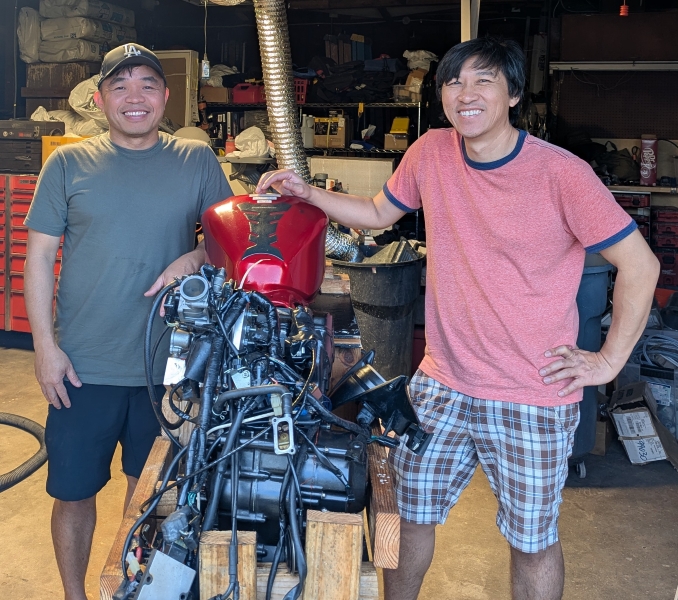
For our concept prototype setup, we used a Honda CBR250R single-cylinder engine with modified intake and exhaust pathways. Because gasoline engines rely on throttle response, we adapted a manual EGR valve to manually adjust EGR levels, allowing us to test and observe engine response to hot EGR introduction.
While higher EGR ratios effectively suppress NOx emissions, they can reduce power output. Recognizing that EGR reduces power in conventional engines, we initialized our concept prototype without EGR, manually increased the EGR ratio, and monitored engine response via RPM indicators. If engine RPM dropped without altering the fueling strategy, it would confirm that the engine was compatible with hot EGR. Conversely, if the engine stalled instantly upon hot EGR insertion, it would indicate incompatibility.
Prototype Results:
Without modifying the fueling strategy, the Honda CBR250R engine idled at 1500 RPM. With manual hot EGR insertion applied in small increments, we successfully decreased engine RPM by 200 RPM to approximately 1300 RPM (the engine would stall if RPM dropped below 1300 RPM). With this positive prototyping result, we confirmed that our engine technology utilizing hot EGR is entirely feasible for diesel and other compression-ignition engine platforms.